
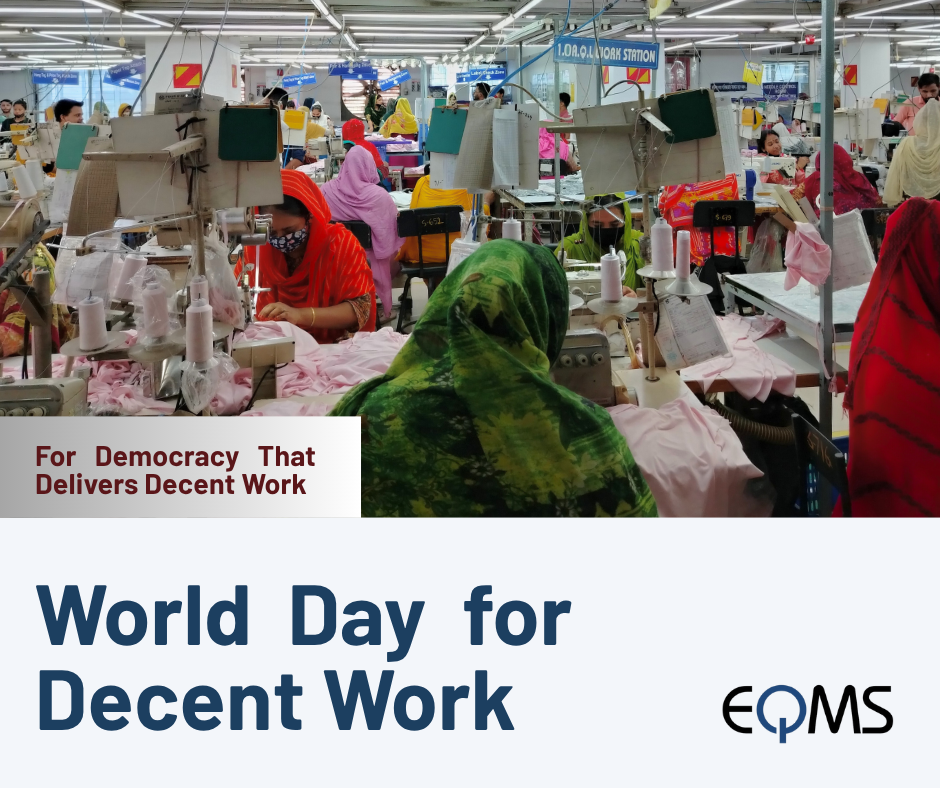
Every year on October 7, the world observes the World Day for Decent Work, a moment to reflect on the conditions, rights, and dignity of working people. This year’s theme, announced by the International Trade Union Confederation (ITUC), is “For Democracy That Delivers Decent Work.” It comes at a time when many economies, including Bangladesh, are expanding rapidly, yet questions remain about whether such growth truly uplifts workers’ lives and strengthens their voices in shaping that progress.
The idea of decent work is not new. It was first articulated by the International Labour Organization (ILO) in 1999 as the right of every person to have productive work in conditions of freedom, equity, security, and dignity. It reflects a holistic vision of employment: one that combines fair income, workplace safety, social protection, and the ability to participate in decisions that affect one’s life. In Bangladesh, this vision resonates deeply. The nation’s development journey, from garments to energy and infrastructure, has created millions of jobs, yet persistent challenges remain: wage disparities, limited worker representation, gender-based inequalities, and the vulnerability of informal labor. The pursuit of decent work, therefore, becomes not only a moral goal but a development necessity.
Globally, financial institutions have embedded this vision into their social safeguard frameworks. The World Bank’s Environmental and Social Standard 2 (ESS2) ensures that project workers are protected from exploitation, provided equitable opportunities, and safeguarded against forced or child labor. Similarly, the International Finance Corporation (IFC), through its Performance Standard 2 on Labor and Working Conditions, calls for fair treatment, non-discrimination, safe workplaces, and respect for workers’ rights to organize. The Asian Development Bank (ADB) upholds these same commitments through its Safeguard Policy Statement and Social Protection Strategy, both of which tie project financing to adherence to core labor standards, gender equality, and inclusion of vulnerable groups. Within the corporate world, the Global Reporting Initiative (GRI) standards, particularly the topic standards on social matters, translate these commitments into measurable indicators: fair wages, safe workplaces, diversity, training, and transparent labor practices.
In Bangladesh’s national context, these global frameworks align closely with the Bangladesh Labour Act of 2006 (amended in 2018), which lays out regulations for fair wages, working hours, maternity protection, and occupational health and safety, alongside the right to unionize. Together, these principles form a foundation on which the idea of decent work can take root, a foundation that links international standards with local governance and everyday realities.
This year’s World Day for Decent Work theme, “For Democracy That Delivers Decent Work”, adds another layer to this understanding. It reminds us that decent work cannot thrive in isolation from democratic governance. Without transparency, accountability, and dialogue, the best labor laws risk remaining on paper. True progress emerges only when institutions listen to workers, when participation replaces exclusion, and when growth is built on equity rather than hierarchy. In the context of Bangladesh’s development, democracy that delivers decent work means ensuring that every infrastructure project, every factory floor, and every policy decision translates into fairness, opportunity, and safety for those who make progress possible.
For over two decades, EQMS Consulting Limited has been advancing this very vision across Bangladesh and beyond. Through its multidisciplinary expertise in environmental and social safeguards, resettlement planning and implementation, livelihood restoration, gender inclusion, and sustainability reporting, EQMS has helped translate the global Decent Work agenda into practice on the ground. Whether preparing Resettlement Action Plans (RAPs) that restore livelihoods, developing Environmental and Social Management Plans (ESMPs) that safeguard worker welfare, or facilitating participatory consultations that give voice to vulnerable communities, EQMS’s work ensures that development is both productive and just.
In large-scale infrastructure and energy projects, EQMS integrates Occupational Health and Safety (OHS) measures, grievance redress mechanisms, and comprehensive human resource (HR) policies that protect workers from discrimination and ensure equal opportunities for all. These initiatives reflect compliance with relevant national laws and policies, including the Bangladesh Labour Act, 2006 (amended 2018), the Bangladesh Labour Rules, 2015, and the National Occupational Health and Safety Policy, 2013, as well as alignment with international frameworks such as those of the IFC, World Bank, and ADB. Together, these standards underscore EQMS’s deeper commitment to human dignity, equity, and fairness.
Beyond safeguards, EQMS’s work in gender and youth empowerment exemplifies how Decent Work principles can reshape lives. Through collaborations with partners from government and non-government sectors, EQMS has developed programs that help women and young people access training, leadership roles, and safer workplaces. These efforts directly address one of Bangladesh’s most pressing development needs: transforming participation into empowerment, and empowerment into leadership.
At the same time, EQMS supports the ready-made garment (RMG) sector in meeting international ESG and GRI standards. By developing sustainability reports for RMG factories, EQMS promotes corporate transparency on issues like wages, safety, and worker well-being. Internally, the company practices what it advocates — offering fair employment, gender-balanced recruitment, staff training, and a healthy work-life environment — embodying the very ethos of decent work it helps others achieve.
As Bangladesh prepares to graduate from Least Developed Country (LDC) status, the challenge ahead is clear: to make growth not only fast but fair, not only profitable but participatory. Democracy that delivers decent work requires more than laws and policies; it requires institutions that are responsive, businesses that are accountable, and citizens who are empowered to shape the conditions of their labor.
EQMS Consulting Limited stands committed to this journey. By bridging global commitments with local realities, it continues to transform the principles of Decent Work into lived experiences: ensuring that every project, every policy, and every partnership contributes not only to economic success but to human dignity, equality, and justice. Because democracy that delivers decent work is, ultimately, democracy that delivers for everyone.
Share this page via